Estimated reading time: 12 minutes
Introduction to the Cargo Cage System
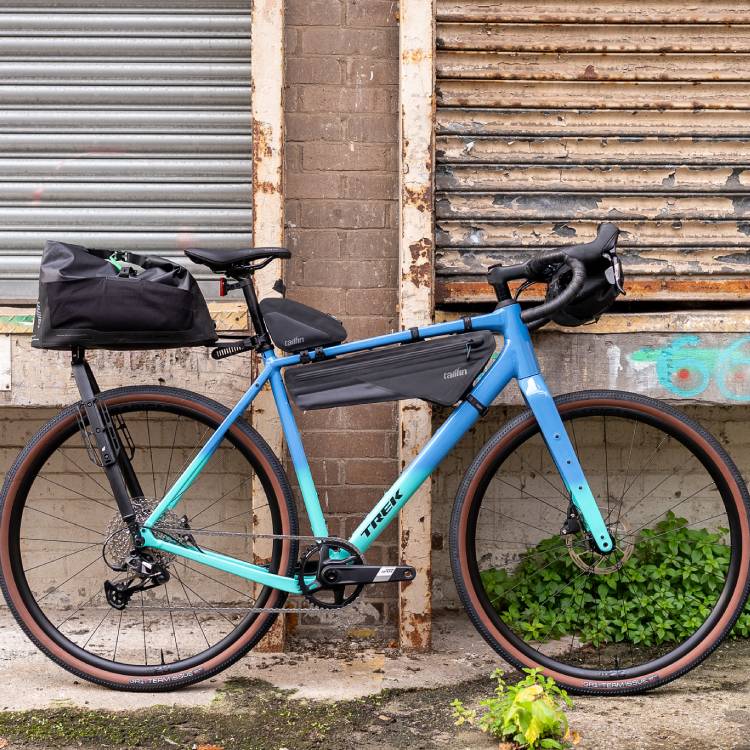
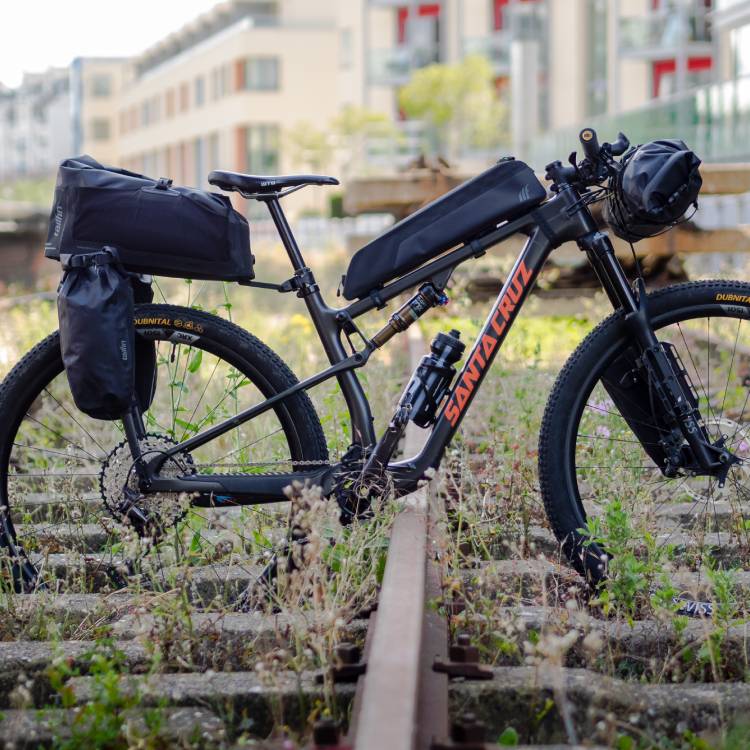
We have our iconic pairings in the bikepacking world, and right at the top of the list are Cargo Cages and Cage Packs. It’s common knowledge that this pairing is one of the most straightforward and low-tech methods for getting more kit on your bike. As long as you have the mounting points, granted. It’s a technique which is pretty excellent at delivering increased volume without needing a tonne of technical equipment, and may suit most bikepackers’ needs.
The Cargo Cage System is made up primarily of Cargo Cages, Cage Packs, and finally, Cargo Straps.
Cargo Cages
What is a Cargo Cage?
The term ‘Cargo Cage’ is an all-encompassing term given for what is, in many cases, an oversized bike bottle cage or something that looks pretty similar to an ordinary bottle cage. It provides a secure base upon which you can mount almost anything you wish to carry and ensures those items stay put when strapped in place.

Construction and materials
Most cargo cages are made from steel or aluminium tubing, sheet metal or a plastic composite – much in the same way as a standard water bottle cage – and sometimes made of lighter (and more expensive) titanium.
The Tailfin Cargo Cages are CNC machined from 7075-T6 aluminium, the highest grade used in the cycle industry, creating a cage that is stronger and far less likely to fail when in use compared to welded or sheet metal versions. And did we mention that this construction method also makes the Cargo Cage super light? How does a weight from 57 grams sound?
The Tailfin USP
The Tailfin Cargo Cage’s party trick, one which sets it apart from the competition is its modular design. By adding or removing the Load Chip the cargo cage can be used either as a cradle or transformed into a heavy load supporting ‘L’ shaped cage. This modularity allows for greater functionality and a far wider range of uses. A single cage can now be used to carry everything from long items such as tent poles and fishing rods to shorter, bulkier items such as cook kits, water bottles and dry bike bags.
The 3 sizes explained
Unlike most cargo cages on the market, it is available in three sizes: Mini, Small and Large. The Mini is mounted with two bolts, the Small with either two or three, and the Large can be mounted with anything from two to four bolts. The size and shape of the cages mean you can fit one to almost any location on a bike that has bottle cage or cargo mounts – be it the frame, fork or Tailfin rack system.
The carefully chosen 72mm width ensures a clean fit to the underside of the down tube regardless of Q-factor. The low profile design when in cradle mode places the cage close to the fork and frame, providing far less risk of snagging on rocks or larger obstacles when riding unloaded.


Fitting Cargo Cages to your bike
Many of us are riding bikes that are more than capable of mounting a cargo cage or two (or three or four…) with ease. In the most part, a cargo cage will fit anywhere you would normally mount a water bottle, thanks to the fact that almost all cargo cages feature mounting holes that share the same spacing as a regular bottle cage.
Alongside the ability to fit a cargo cage wherever your bike frame has bottle cage mounts, plenty of us are riding bikes that already have dedicated cargo cage mounts on – usually on rigid fork legs or seat stays. Yes, if you didn’t already know it, those three (or sometimes four) threaded holes on your bike’s fork legs are designed for fitting cargo cages, allowing for turbo-charged load carrying. When added to the typical two-bottle cage mounting points within the bike frame and the increasing popularity for bike brands to stick another set of bottle cage mounts underneath the down tube, these mounts can give rise to five individual locations where a cargo cage can be fitted.
You can also fit Cargo Cages to your MTB suspension forks. Read more on this below.


Cage Packs
What is a Cage Pack?
Simply put, Cage Packs are fully waterproof, bikepacking-specific dry bags. The engineered Speed Hook system provides a reliable and repeatable mounting process, whilst still enabling rapid removal.
Tailfin Cage Packs vs a regular dry bag
Dry bags are great; they’re cheap, lightweight and readily available. However, they’re far from perfect. Here, we’ve tried to highlight the problems that exist:
- Time-consuming nature of threading straps through daisy chain style bag attachments
- The need to have multiple hands to hold the bag in place and tighten straps
- Poor alignment between cage and bag
- Limited ability to adjust the height of the bag in relation to the cage
- Standard dry bag dimensions are only really suited for use on forks
Our Cage Packs alleviate all these issues through 2 simple design solutions.
Size and shape: Our expertise in using laminated materials, combined with our construction techniques, enabled us to get away from the typical, basic cylindrical shape employed by many dry bags. Instead, we can create more complex forms that are perfect for use in areas where clearances are essential, such as within the frame or under the down tube. If you’ve ever felt the annoyance of rubbing your leg on an ill-fitting frame bag or noticed your bottle or bag being worn through by the chainring when fitted under the downtube, this aspect of our design will resonate.
The ‘Speed Hook’ concept: The pièce de résistance of the Cage Pack system has to be the in-built Speed Hooks. These small but perfectly formed thermoplastic hooks might look inconspicuous, but elevate the Cage Pack to more than just a well-appointed dry bag.
Bike bag construction
Whilst it may be devoid of the characteristic Tailfin internal structure, the Cage Pack system retains the typical Tailfin innovation you would typically expect. We continue to use the combination of heavy-duty 420D Hypalon laminate in high wear areas and lighter, more flexible ripstop nylon in all other areas to create a very comfortable shape. Roll-top closure provides easy, weatherproof access. As with all Tailfin technical bikepacking bags, we construct the Cage Pack using a process of welding the fabrics together to create a completely watertight, seam-free package. This construction method guarantees the Cage Packs are 100% waterproof – a feature that provides great peace of mind when carrying your essential camping and safety kit.
Sizing: 1.7L vs 3L
It boils down to personal preference, and can be very bike specific, but as a simple rule of thumb, we’d advise the 1.7L for road/gravel bikes, and the 3L version for bigger MTBs, although the thinner 1.7L Pack will fit on a MTB downtube, too.
The smallest 1.7-litre Cage Pack can carry items equivalent in volume and dimensions to a standard 74mm diameter water bottle. It also has a maximum width, allowing it to fit within the standard q-factor/bottom bracket width of a road or gravel bike.
The 3-litre Cage Pack fits within the standard q-factor/bottom bracket width of a mountain bike.
The 5L Cage Packs are too wide to fit on the downtube of bikes, and are best suited to Fork mounting or on the side of our alloy arches, which have mounting bosses.


Cargo Straps
What is the Cargo Strap?
The Tailfin Cargo Straps have been designed from the ground up specifically for bikepacking use. You can use them to strap a Cage Pack or dry bag to a Cargo Cage or to attach additional loads to your bike. Tuned TPU (Thermoplastic Polyurethane) strap material offers the perfect blend of stretch, strength, and durability.
When we say they’re built for the rigours of bikepacking, we mean that:
- They’re shaped with bicycle frame tubing in mind and ulitise non-scratching materials
- They have a refined hook and eyelet to ensure snappy closure when strapping around soft bags
- They lock in place when riding on tough terrain through a self-locking hook design
Speed Hook
The Speed Hook is our answer to addressing the top three issues research led us to identify as the problems to rectify when it comes to failings in the cargo cage/dry bag system.
- The time-consuming nature of threading straps through daisy chain-style bike bag attachments
- The need to have multiple hands to hold the bag in place and tighten straps
- Poor alignment between cage and bike bag

Strap Length
We specifically designed three strap lengths to match the storage capacity of the three different volume Cage Packs. When you order a set of straps with a Cage Pack we will provide the most suitable length.
Our pairings are:
- 1.7L Cage Pack + 40cm strap length
- 3L Cage Pack + 50cm strap length
- 5L Cage Pack + 65cm strap length

Suspension Fork Mounts (SFMs)
What are Suspension Fork Mounts (SFMs)?
The SFM is a universal clamp system that enables suspension fork users to mount cargo or water bottle cages to the lower leg of the fork.
Once fitted, they allow the carrying of additional cargo types, such as cages or water bottle cages, allowing you to carry up to two additional cages per leg. With a load rating of 3kg, they are built for the trail.
We also have an SFM deep-dive blog if you want to read more about the design process.

Carbon vs. Alloy
Weight is the key difference between the two versions. The performance of both the carbon and stainless steel SFM is comparable. The overall look of the two different materials is, of course, slightly different.
Carbon fibre and stainless steel were chosen as materials for making the SFM, as one of the key properties of both is the ability to resist an effect called ‘creep’. Creep is an impact associated with products manufactured from polymeric materials (plastics) whereby any increased strain, even that under the recommended level. It occurs as a function of time through extended exposure to levels of stress that are below the yield strength of the material.
Given sufficient time, this can lead to creep rupture, the failure within a material as a result of continuously applied stress at a level below the tensile strength. Plastic materials are particularly prone to creep rupture through exposure to static stresses. Simple answer: carbon and steel SFMs will last longer and perform better than plastic counterparts.


Fitting to your forks
Swap out hardware enables a solid grip on forks with lower diameters of 36-45mm, covering the most popular forks from brands such as Fox and RockShox.
A single bolt attachment makes the SFM installation a breeze. You can use our installation instructions to help.
Currently, forks with a leg diameter lower than 38mm or larger than 45mm are not accommodated. Luckily, most modern suspension forks, barring long travel forks such as Fox’s 38 or RockShox’s Zeb, fall between the recommended dimensions.
Please note the SFMs are not compatible with the Fox 34 Step-Cast 2022/23 Fork (earlier models are compatible).
If you’ve got any additional questions or cannot find all the information you need, feel free to contact our Customer Service team.