Estimated reading time: 5 minutes
Note: This guide references our AeroPack, now available as the CargoPack system or as part of our modular Pannier Rack range.
Shorter riders can struggle to carry everything they want for bikepacking and commuting. A smaller frame reduces the space available. Riders often have to compromise on bag size in order not to ‘buzz’ their rear tyre.
Tailfin’s Rear Systems overcome many of the shortfalls of traditional seat packs. Set up correctly, they’re a great option for smaller riders. Detailed below are some tips we have for setting up a small bike with Tailfin products.
Extensions
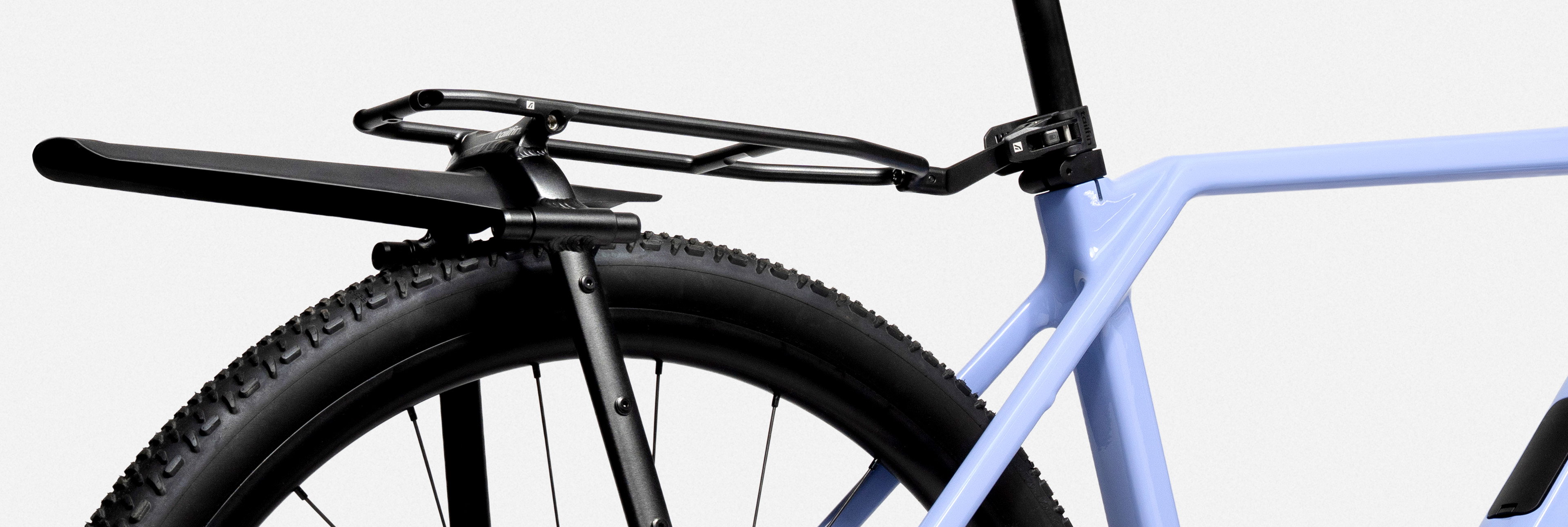
If your frame is size XS-L and/or you have less than 10cm of seatpost showing, we strongly recommend you choose the XS-L bike size option when selecting your TopStay in your Rack configuration. CargoPacks now come with a ‘long’ Seat Post Connector as standard. This feature was previously an optional extra and is still available on our site for customers with Gen 1 Top Bags (pre January 2026). You can check what generation your Top Bag is using with our Guide.
The SpeedPack, however, includes the most adjustability with 3 lengths of connectors (30, 60 and 90mm) for more options with a range of bikes. Choosing the longer versions will mean the bag is held further back, to help maximise the space available. It also has a lower profile, so it will fit more easily under/behind a saddle.
You may wonder why even longer extensions on our Rear Systems are not available. The quick answer is durability. We have found that extensions that are too long increase the risk of the part failing (the longer the extension, the more it begins to act as a lever and could snap). The products have been tested to carry the recommended weights on the product pages.
Packing
The next piece of advice regards packing the Top Bag. The CargoPack bag, used on Racks and CargoPacks, is subtly wedge-shaped – smaller at the front and larger at the back. As such, we recommend packing smaller/softer items at the front of the bag (beneath your saddle) and bulkier/heavier items towards the back. Don’t worry, though, as the bag is top opening, it’s still incredibly easy to view and access the contents (unlike seat packs, which often require unpacking everything to grab something at the bottom).
The 10L SpeedPack is slightly different, though, with access at the rear of the bag. The nose of the bag is even more tapered than its larger 18L CargoPack relative, to maximise fit with as many bikes as possible – particularly ideal for small frames or full-suspension MTBs.
A final packing tip is to open the side zip or air valve before rolling the bag shut. This will help expel any air and allow you to compress the bag to a smaller size, too.


Positioning
Where you attach the Rack, CargoPack to your seatpost can affect the total capacity. We’ve found that positioning the seat post connector higher up helps on small frames. The image below shows the difference in position (shown on a Cannondale Topstone in size XS; their smallest frame size).
For the SpeedPack, though, you’ll find that, due to the increased adjustability the different connectors give you, mounting it lower will give you more space under the saddle and behind the seatpost (shown on a Trek Emonda ALR 5, 50cm/S).


Spread the load
Lastly, if you’re heading away on a longer trip consider additional bags for the extra items you’ll likely need. We have a range of Panniers, Fork Packs, Top Tube Packs, Frame Bags, Downtube Packs and Bar Systems suitable for small frames – enough extra capacity for any adventure.
The Trek Domane SL6 Gen 4 in a size 47/XS is shown fitted with the SpeedPack, 1.1L Flip TopTube Bag and 2.3L Half Frame Bag.
You may find that fitting a Bottle Dropper will help maximise frame space available for bottles, too.