Open contents
If you’ve ever looked at a bikepacking photo online – someone crossing a mountain pass at sunrise, fully loaded, seemingly immune to effort – and thought “that looks incredible, where would I even start?,” this article is for you.
Because here’s the thing. That person on the mountain pass probably started exactly where you are right now: a bit curious, a bit nervous, googling things like “what bags do I even need” at 11pm. Bikepacking isn’t a sport reserved for ultra-athletes or gear obsessives. It’s just riding your bike somewhere – and bringing enough stuff to sleep there.
That’s genuinely it.
We’re here to explain bikepacking, demystify the gear, and help you figure out what your first trip might actually look like, and leave you feeling like this is something you could actually do.
Spoiler: Because it is!

What is bikepacking?
It’s just riding bikes with stuff on them

Bikepacking is, at its simplest, going on a bike ride and bringing what you need to spend the night somewhere. That somewhere might be a campsite, a bothy, a hotel, a field with permission, or the spare room of a friend who lives two days away. There’s no single template.
The word “bikepacking” tends to conjure images of wild camping in remote landscapes, and yes, that’s one version of it. But so is a one-night loop from your doorstep, finishing at a pub where you’ve already booked a room. It’s all bikepacking. The common thread is self-sufficiency – carrying what you need on your bike, under your own power, going somewhere because you want to.
How is bikepacking different from cycle touring?
You might have heard of cycle touring, which is a closely related activity where riders carry gear on their bikes, often for weeks at a time across countries or continents. Touring traditionally uses panniers – those big bags that hang from racks on your front and rear wheels. Think: fully loaded, heavy, deliberately paced.
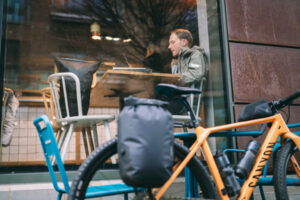
Bikepacking tends to use a more integrated approach: bags that attach directly to the frame, fork, or handlebars, keeping the weight closer to the bike’s centre of gravity. This generally makes the bike more nimble, more capable off-road, and less likely to feel like you’re riding a wardrobe.
That said, the line between the two is blurry and doesn’t really matter. Both are brilliant. Use whatever bags work for you. Call it whatever you want.
Why people love it

There’s something uniquely satisfying about arriving somewhere under your own power, with everything you need right there on the bike. The world opens up in a way it doesn’t from a car. You smell things. You notice things. You talk to people at petrol stations who ask where you’re headed, and the look on their face when you tell them is quietly wonderful.
Do you need a special bike to go bikepacking?

Almost any bike works
No. You do not need a special bike. This is probably the most important thing to say early, because “but I don’t have the right bike” is one of the most common reasons people put this off – and it’s largely unfounded.
The best bike for your first bikepacking trip is the bike you already own. Full stop. We’ve seen people complete multi-day adventures on 1990s mountain bikes, on city hybrids with flat bars, on road bikes with thin tyres, on bikes that probably should have been retired a decade ago. The bike gets you there. That’s its job. It does not need to be optimised. The beauty of bikepacking bags (unlike traditional touring setups) is that they work with almost any bike – old or new, steel or carbon, drop bars or flat.
Road bikes, MTBs, gravel, hybrids are all fair game
Here’s a rough breakdown of what different bikes handle well on a bikepacking trip:
Mountain bikes: brilliant off-road, comfortable on rough terrain, naturally suited to carrying weight. Slower on tarmac, but very capable overall.
Gravel bikes: arguably the current sweet spot for most bikepackers – fast enough on road, capable enough off it. Wide tyre clearance helps a lot.
Road bikes: perfectly fine on tarmac routes, and a surprising number of road riders have discovered bikepacking this way. Just plan routes that keep you on smoother surfaces.
Hybrids and city bikes: absolutely usable, especially on well-surfaced routes. You might have fewer attachment points for bags, but that’s solvable.
Hardtail mountain bikes: a classic choice. Simple, reliable, good bag attachment options, handles varied terrain well.
If you’re planning on mostly gravel tracks or off-road riding, something with wider tyres (40mm+) will make your life significantly more comfortable. But if your first trip is along cycle paths and quiet roads? Your road bike will do beautifully.
When to think about upgrading
If you catch the bikepacking bug – and many people do – you might eventually find yourself wanting something more purpose-built. A gravel bike with more tyre clearance, or a frame with more attachment points for bags. But that conversation is for later. For now, ride what you have. You’ll learn what sort of routes, terrain, and distances you enjoy and that will help inform any future bike decisions.
What to bring bikepacking?

The short answer: less than you think
The gear question is where a lot of beginners get stuck – usually because they go down a rabbit hole of forums and YouTube videos and come out the other side convinced they need to spend £800 before they can ride anywhere.
You don’t.
For a one-night trip in summer, a reasonable kit list fits in a bag the size of a medium rucksack. The trick is to pack for the trip you’re actually doing, not the hypothetical extreme version of it.
Here’s how to think through the main categories:
Bags: where to start

Bikepacking bags are how you carry everything. They attach to different parts of the bike, and different bags suit different needs:
Frame bag: sits inside the triangle of your bike frame. Great for heavy or dense items – tools, food, a water filter. Keeps weight low and central.
Handlebar bag: attaches to the front of your bike at the bars. Good for bulky, lightweight items like a sleeping bag or puffy jacket.
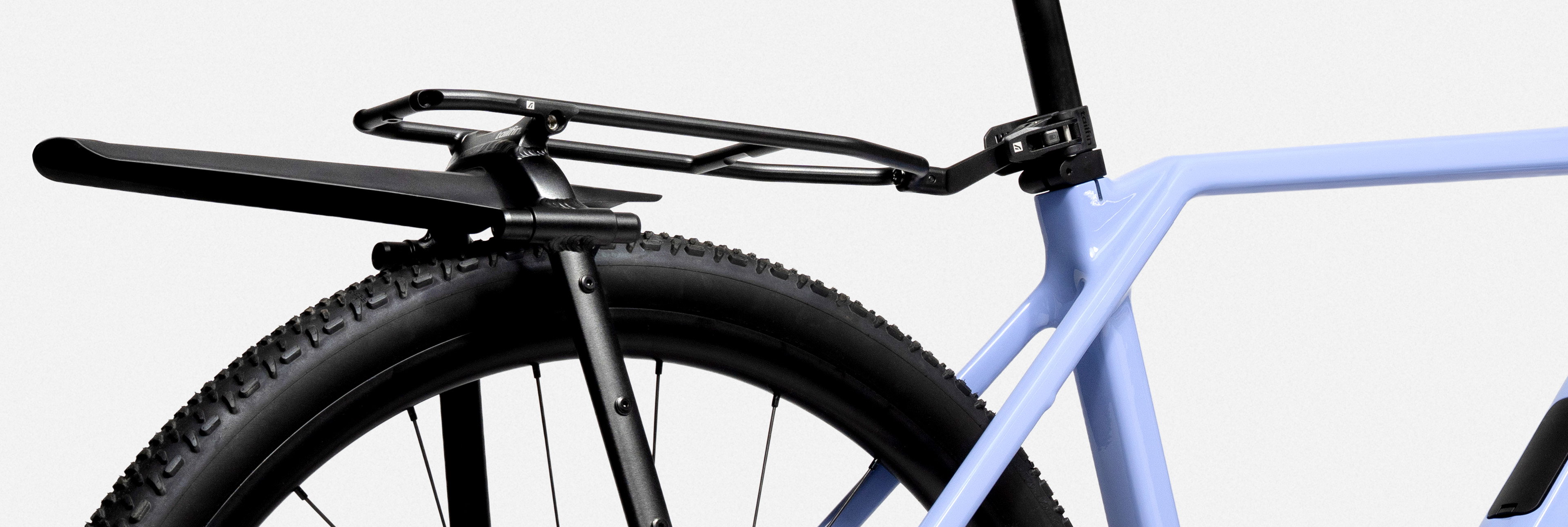
Rear Systems: Behind your seat, usually the biggest single bag on the bike – good for your tent or shelter and spare clothes. A CargoPack or SpeedPack here is a good choice, and can be packed without the worry of the bag swaying from side to side that can be an issue with traditional saddle bags.
Top tube bag: the small bag that sits along the top of your frame, within easy reach. Perfect for snacks, your phone, sunscreen. Things you want without stopping.
Feed pouches: small open-top pouches that clip onto your handlebars. Great for water bottles if your frame doesn’t have bottle mounts (or if they’re taken up by a frame bag).
You don’t need all of these for your first trip. A handlebar bag (or even basic dry bag strapped to your bars), a saddle bag or rear system, and a small frame or top tube bag is a very common starter setup that’ll handle most overnighters comfortably.
Sleeping and shelter

This depends a lot on where you’re sleeping. If you’ve booked a room or a hostel bunk, you can skip this entirely – your sleeping kit is probably a toothbrush and a change of clothes.
For wild camping or campsites, you’ll generally want:
- A sleeping bag rated to the temperatures you’ll be in. For a UK summer overnighter, a 3-season bag is usually fine. Check the forecast.
- A sleeping mat. This matters more than most beginners expect – it’s about insulation from the ground as much as comfort. Inflatable mats pack small and have different temperature ratings, like sleeping bags. A foam roll or folding mat is cheap and indestructible, but offers little insulation from cold ground.
- Some form of shelter. A lightweight tent, tarp, or bivy (a weatherproof shell for your sleeping bag) for camping, or a hotel, hostel, or bnb reservation.
Your sleeping bag is probably the bulkiest item you’ll carry. A down bag compresses smaller than synthetic, but synthetic is more forgiving when wet. For a first trip, use whatever you already own. If you don’t own one, look at Alpkit, Naturehike, and Mountain Warehouse for affordable options in both categories.
Note: wild camping is only legal in Scotland and Dartmoor in the UK. Elsewhere, you’ll need landowner permission or a designated campsite.
What to wear

Wear what you usually ride in and make sure it’s kit that you know will be comfortable. If you have padded shorts, wear them – a saddle becomes a different object after 60km. A waterproof layer is worth packing regardless of the forecast; it takes up almost no space and will save you at some point.
For off-bike clothes, one set of warm/dry layers to change into in the evening is usually enough.
Food and water
For most routes in the UK and Europe, you’ll pass through towns and villages where you can buy food. Planning your route around this is genuinely a good strategy – it keeps your bags lighter and gives you something to look forward to.
Carry enough food to bridge the gaps between stops, and always carry more water than you think you’ll need. A soft flask takes up almost no space when empty.
For more remote routes or off-grid adventures, you’ll want to plan your water sources in advance. A filter (like a Sawyer Squeeze) is a lightweight, reasonably cheap way to drink from streams safely. But for a first trip, stay near civilisation.
How far should you ride?

Start laughably small
If your instinct is to plan 80km on your first trip, plan 40km instead. If you’re eyeing 40km, try 25km. The point of your first bikepacking trip isn’t to test your limits – it’s to have a good time and come home wanting to do it again.
The most common beginner mistake isn’t going too easy. It’s going too hard, arriving exhausted at camp with the last of the light, and spending the evening too tired to enjoy where you are. Bikepacking is supposed to be enjoyable. Give yourself permission to take it easy.
Distance vs. time: think in hours, not miles
A loaded bike rides slower than an unloaded one. Rough terrain rides slower than tarmac. You’ll stop more often than you expect – for food, for photos, for a gate that won’t open, for five minutes sitting on a wall eating a biscuit because it’s a nice wall.

A useful rough guide: plan for 12-15km per hour on a loaded bike on mixed terrain. So a 50km day is realistically 4-5 hours of riding – plus breaks, plus time to set up camp. A 60-70km day is plenty for most beginners. Some people’s first trips are 20km and they’ve had the best weekend of the year.
Think in hours on the bike, not miles. “I want to spend 3 hours riding on Saturday” is a much healthier starting point than “I want to cover 80km.” Remember, a hilly 40km feels nothing like a flat 40km!
What a first trip might actually look like
Here’s a completely realistic first bikepacking trip: Leave home on a Saturday morning. Ride 40km to a campsite you’ve booked in advance. Set up. Eat a good meal. Sleep. Ride 40km home on Sunday. You’ve had a great weekend!
That’s it. And it will feel like an adventure, because it is one. You’ll have ridden your bike somewhere under your own power, slept there, and ridden home. That’s the whole thing.
Alternatively: stay in a B&B, or a hostel, or a friend’s house. You don’t have to camp. Some of the best bikepackers we know are very enthusiastic about beds.
A first trip could be anything, an overnighter, or a more ambitious trip across Europe. Here are two examples from the Tailfin Team.
Dan – I had cycled all my life, but it was always routes that started and ended in the same place, or simply for transportation. My first experience of bikepacking was Tailfin Detours, which took place across the Brecon Beacons and covered roughly 60 miles on the first day and 25 on the second.
This was well outside my comfort zone, as I hadn’t really cycled those kinds of distances and terrain before, and I’d never ridden a fully loaded bike. I did it with a mate who was at a similar level of experience, so we were figuring it out and working hard together.
It was such a rewarding experience when we finished, and it brought me and that friend even closer. There’s something incredibly freeing about being fully self-sufficient with everything I needed on my bike.
Rob – My first proper bikepacking trip was in France. My wife and I got the ferry over and rode a section of EuroVelo 4, going from Roscoff to Saint-Malo along the Brittany coast.
My wife isn’t normally that into cycling – she definitely wouldn’t choose to ride around the city for fun – but this felt completely different. The trip was more about swimming in nice places than just cycling for her.
Most days were spent riding quiet coastal roads and bike paths, stopping early in the afternoon for cider, nice food, and swimming in the sea.
We took it slowly, 250km over five or six days. Not covering big miles kept it really low-stress. We also didn’t need to book any campsites, we just turned up each afternoon and there was always space. The whole route is really well signposted too, so there was almost no navigation – we could just follow the little green signs.
At the end we got the ferry back to Portsmouth and then the train back to Bristol. The whole thing was super easy.
Planning your first route
Use free tools
You don’t need specialised routing software to plan a bikepacking route. The tools most riders use are free, well-tested, and reasonably easy to pick up:
– Komoot: probably the most popular bikepacking route planning tool. Good surface type data, community-verified routes, and clear difficulty ratings. Free tier is generous.
– RideWithGPS: more common in road cycling circles but excellent for bikepacking too. Clean interface, good elevation profiles.
– OS Maps (UK): Essential if you’re heading off-road – the Ordnance Survey is the gold standard for understanding footpaths, bridleways (legal on a bike), and byways (also legal, but shared with vehicles).
– Trailforks or Wikiloc: useful if you’re planning more trail-focused off-road riding.
For a first route, Komoot is probably the most beginner-friendly. Set your activity type to “gravel” or “touring” depending on your bike, and it’ll suggest surfaces accordingly.
Think in loops or point-to-point with a return
Two simple shapes cover most bikepacking routes:
– A loop: you start and finish at the same place. Logistically very easy. Nobody needs to drive anywhere. Great if you’re starting from home.
– Point-to-point: you ride from A to B. This requires either a friend with a car, public transport back, or a bike-friendly train. Check this in advance – UK trains vary wildly in their bike policies, and some require reservations.
For a first trip, a loop that starts and ends at home (or a train station) is usually the most stress-free option. You’re not navigating any logistics on top of all the other new things.
Find where others have ridden
You don’t have to invent your route from scratch. Most bikepacking communities share GPS tracks freely. Komoot, Strava, and dedicated bikepacking sites like Bikepacking.com have a wealth of existing routes that other people have done, reviewed, and often photographed.
Starting with a known route removes a layer of uncertainty that can be mentally tiring on a first trip. You know the surfaces are rideable. You know roughly what you’re in for. You can focus on the actual riding.
That said – don’t be afraid to make it your own. If you want to extend a section to visit a specific viewpoint, do it. Bikepacking is most fun when it’s personal.
Common beginner worries (answered)
Let’s address the things that quietly put people off, because most of them deserve a much calmer response than the internet usually gives them.
What if something breaks?
Something might break. This is part of riding bikes. The good news is that most mechanical issues on a bikepacking trip are either fixable roadside or fixable with a quick visit to a bike shop in the next town.
The basics you should carry: a spare inner tube (include a tubeless plug kit if you’re running tubeless, but don’t rely on it), a pump, tyre levers, a multi-tool, a chain quicklink, and a patch kit. If you know how to fix a puncture, you’re prepared for 90% of what’s likely to go wrong.
Most bikepacking routes pass through towns. Bike shops exist. People are remarkably helpful. In all the years the Tailfin team have been riding, we’ve never seen a trip genuinely derailed by something that couldn’t be fixed or worked around
What if I’m not fit enough?
You are probably fitter than you think. And even if you’re not – bikepacking has a built-in pace adjuster: you go as fast or slow as you want, and stop whenever you need to. There’s no race. There’s no timer. Nobody is watching.
If you’re genuinely new to cycling, a few rides with a loaded bag before your trip will help you get used to the handling.
The loaded bike will make you slower than you’re used to. That’s normal and expected. Plan for it. Pack light. And remember that some of the most memorable bikepacking trips have been the slow ones, where there was time to notice things.
What if I get lost?
Getting slightly wrong-routed is part of bikepacking and is usually fine and sometimes delightful, a missed turn can lead to a beautiful view, unexpected cafe, or a conversation with a friendly farmer. But practically: download your route to your phone before you leave, keep your phone charged and bring a battery pack. A GPS computer is worth it if you ride often, having the map right there on your bars beats fumbling for your phone at every junction.
Komoot and RideWithGPS both have offline maps that work without a signal. A backup paper map or OS map on your phone for the area you’re riding in is sensible, especially for remote stretches. And always tell someone where you’re going and when to expect you back.
What if I hate camping?
Great news: you don’t have to camp. Bikepacking with accommodation is absolutely a thing – people plan multi-day routes between hostels, B&Bs, pubs with rooms, mountain huts, and all sorts of in-between options. The bag setup is the same. The riding is the same. The sleeping arrangements are up to you.
In fact, for a first trip, booking accommodation might remove enough uncertainty to make the whole thing much more enjoyable. There’s nothing wrong with that. Do the version that sounds most fun.
Remember, there is no correct version of bikepacking. The correct version is the one you actually enjoy.
Your first trip: What to expect
The chaos of day one

Here is a warning: your first morning packing everything onto the bike will take longer than you expect. Things won’t fit the way you planned. You’ll repack the frame bag twice. You’ll forget where you put the snacks. You’ll leave the house 45 minutes later than intended.
This is completely normal and it happens to everyone, including experienced bikepackers who’ve done this dozens of times. The first hour of any bikepacking trip involves a certain amount of adjustment – shuffling things around, tightening a strap that’s rubbing, deciding you actually don’t need that extra layer and stuffing it somewhere.
By lunchtime, it’ll all feel much more settled.
The moment it clicks

Somewhere around the middle of day one – usually after you’ve fixed the packing chaos, settled into the pace, and really started noticing the landscape – something shifts. The bike starts feeling right. The weight becomes normal. You realise you’ve been riding for two hours and haven’t thought about work or your phone or anything except where the road is going.
That’s the moment. That’s why people do this.
It might arrive sooner than you think.
What you’ll wish you’d known
Based on the collective experience of a lot of first-timers, here are the things people most often wish they’d known:
Start shorter than feels sensible. Then add more next time.
– Pack lighter than you think you need to. Then lighter still.
– Bike fit and a good saddle are worth prioritising over fancy gear choice.
– Plan around food stops – it’s genuinely more fun than carrying everything.
– Leave early. The best hours to ride are the morning ones.
– Talk to people. They’re almost always friendly and interesting and know good things about the local roads.
– Write it down afterwards. The small moments are the ones you’ll forget, and they’re the best ones.
Where to go from here
This article is meant to be a doorway, not a destination. Once you’ve done your first trip and discovered what you actually care about – whether that’s going further, going lighter, going off-road, or just finding more good pubs to finish at – we have deeper guides for all of it coming soon.